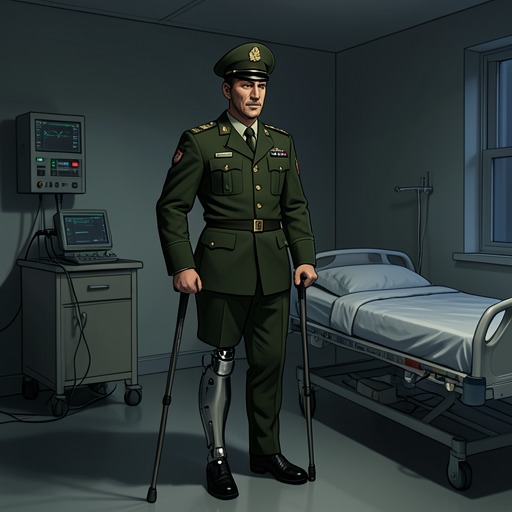
Alvin’s Canadian medal
The Plot Against AmericaAlvin’s Canadian medal is a circular silver service award that Alvin gives Philip after Philip helps him with the everyday difficulties of wearing his artificial leg. Philip keeps it close and hidden beneath his undershirt: a mark of Alvin’s gratitude and their intimacy, but also an object that acquires political weight amid the family’s fears about loyalty and Alvin’s disillusionment.
Form and Transfer
The medal is circular silver, with King George VI in profile on one side and, on the other, a triumphant lion standing on the body of a dragon. Alvin had received it “for performance under exceptional circumstances.” Its transfer to Philip follows a small but consequential act of care. Philip notices that Alvin struggles to pull his trousers over the prosthesis; his mother takes Alvin’s army trousers to a neighborhood seamstress, who adds a zipper to the left leg. When the alteration makes dressing easier, Alvin tells Philip, “I couldn't live without you,” then adds, “I couldn't put my pants on without you,” and gives him the medal to keep forever.
The exchange joins an official mark of military service to an intimate domestic scene. The medal does not pass to Philip as a reward for public achievement: it is Alvin’s personal answer to practical help, offered at a time when Philip has become his attendant and companion. Its inscription-like award language and martial imagery thus acquire a meaning rooted in dependence, gratitude, and shared daily life.
Wearing and Concealment
Philip cherishes the medal and begins wearing it regularly, pinning its narrow green ribbon to his undershirt so that it cannot be seen. He fears that visible possession might lead someone to question his loyalty to the United States. The concealment gives the object two simultaneous meanings: privately, it confirms Philip’s closeness to Alvin; publicly, it could be read as a political sign requiring explanation. Philip removes it only on gym days, when he must take off his outer shirt.
That hidden routine becomes visible to an interrogator who asks whether Philip has heard anything about the president, then specifically asks about Canada and going there. Philip answers truthfully that he has not. He nevertheless becomes certain that the man knows about the medal, reasoning that the close inspection from head to toe has revealed that he is wearing it. The medal’s concealment cannot fully protect it from scrutiny: even without being named in the questioning, it shapes Philip’s sense of what the questions may mean.
A Changing Emblem
The medal’s significance shifts as Philip watches Alvin gamble with Shushy behind the high school. Philip remembers the sacrifices his family made to keep Alvin from becoming a replica of Shushy and thinks bitterly, “Take your fucking medal, gimp, and shove it!” The outburst turns the award’s heroic associations against Alvin’s present conduct: to Philip, the man who once served under exceptional circumstances now appears to be repudiating the ideals that made him a cripple. Yet Philip’s anger also registers how deeply he has attached himself to Alvin; the medal is the object through which that attachment and disappointment come into focus.
The medal therefore gathers several conflicts without resolving them. It is a record of Alvin’s Canadian service, a keepsake given in response to Philip’s care, and a concealed sign that makes political loyalty feel exposed to inspection. Its movement from Alvin to Philip does not settle what Alvin’s service means after his return; instead, the object preserves both the bond between them and Philip’s later struggle to reconcile that bond with Alvin’s choices.